

👋 Hey, Jon here!
LLMs continue to generate buzz and spark debate across our industry. IMO, this is awesome.
Whenever customer behavior shifts or new channels emerge, there’s almost always a market inefficiency you can exploit to gain an edge.
I remember the days when Facebook was new and growing, but the majority of businesses pushed back on advertising within a platform ‘for teenagers’.
AI and LLMs feel much different - people are leaning in, learning and wanting to embrace the change, but there are a lot of competing narratives about how much lead volume these channels drive for contractors today.
So, I summarized the AI referral picture across the SearchLight network: 1,400+ HVAC, plumbing, electrical, and roofing companies, January 2025 through October 21, 2026.
All of it comes from website-side tracking (forms, tracked calls, chats, and scheduler widgets), which is where an AI assistant can actually leave a fingerprint.
The methodology is at the bottom.
Four things about AI lead volume stood out to me:
1. AI referrals are growing fast and are still small
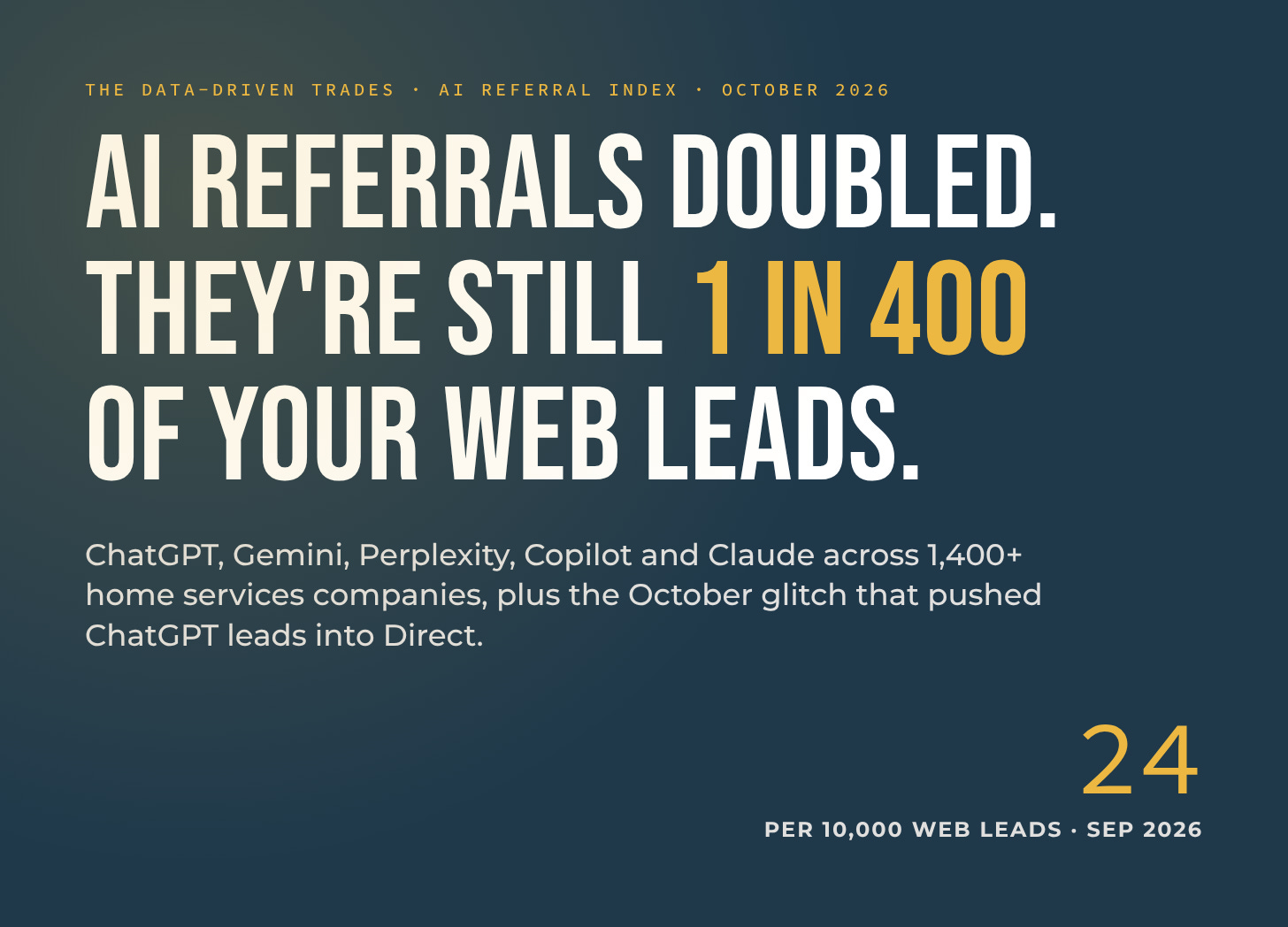
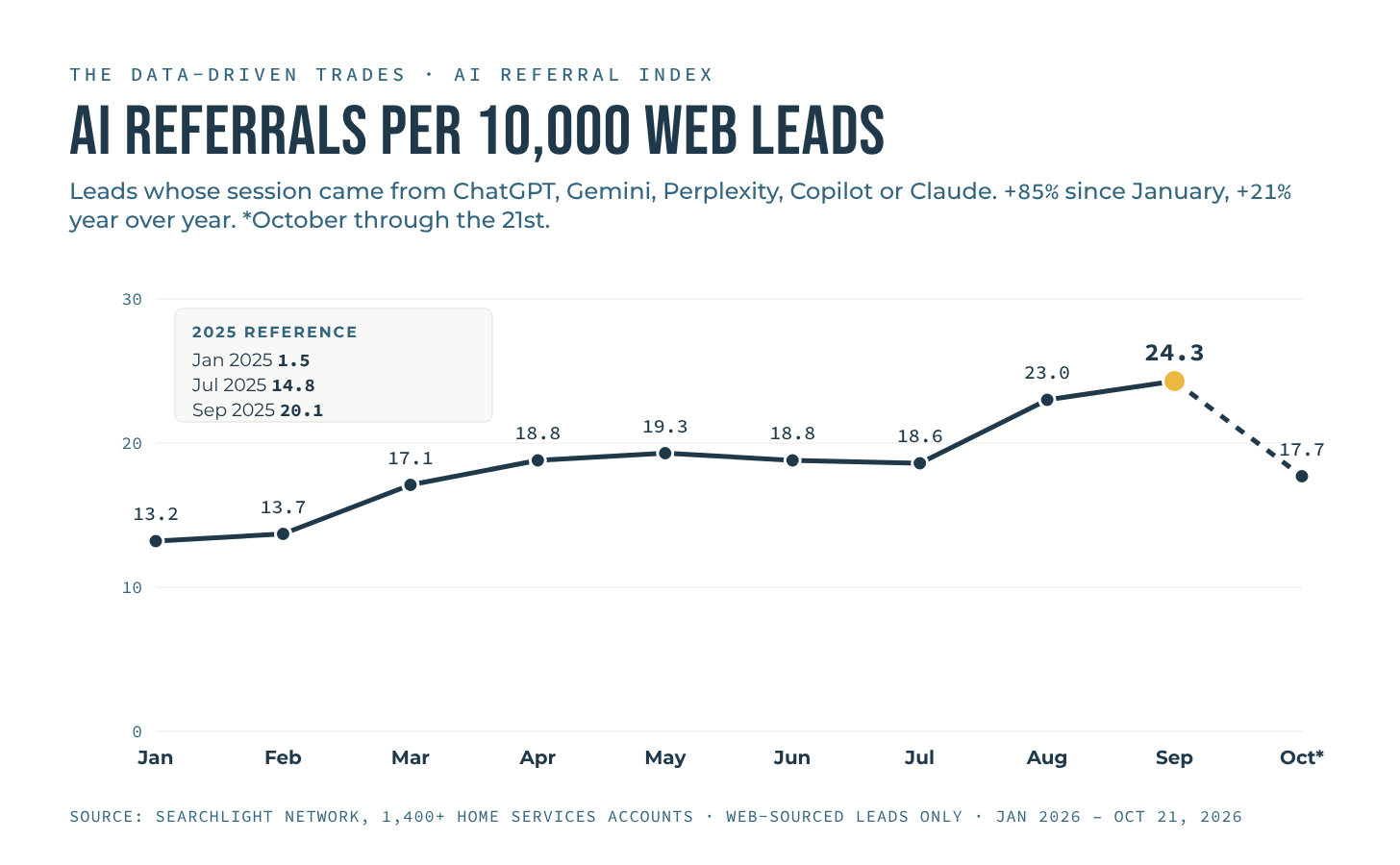
In September 2026, 24 of every 10,000 web leads came from an AI assistant. That’s 0.24%, or about one in 400.
That number is up 85% since January (13 per 10,000) and up 21% year over year (20 per 10,000 in September 2025).
In raw counts, September 2026 produced 2.4x the AI-referred leads of September 2025, but the network grew too, so share is the honest comparison.
In January 2025, it was only 1.5 per 10,000.
So the channel is roughly 16x bigger than it was 21 months ago, but is still very small compared to Google.
AI is the fastest-growing referral source we track, but it's unlikely to be the channel your next 100 jobs will come from.
2. It is a ChatGPT channel, with Gemini coming up behind it
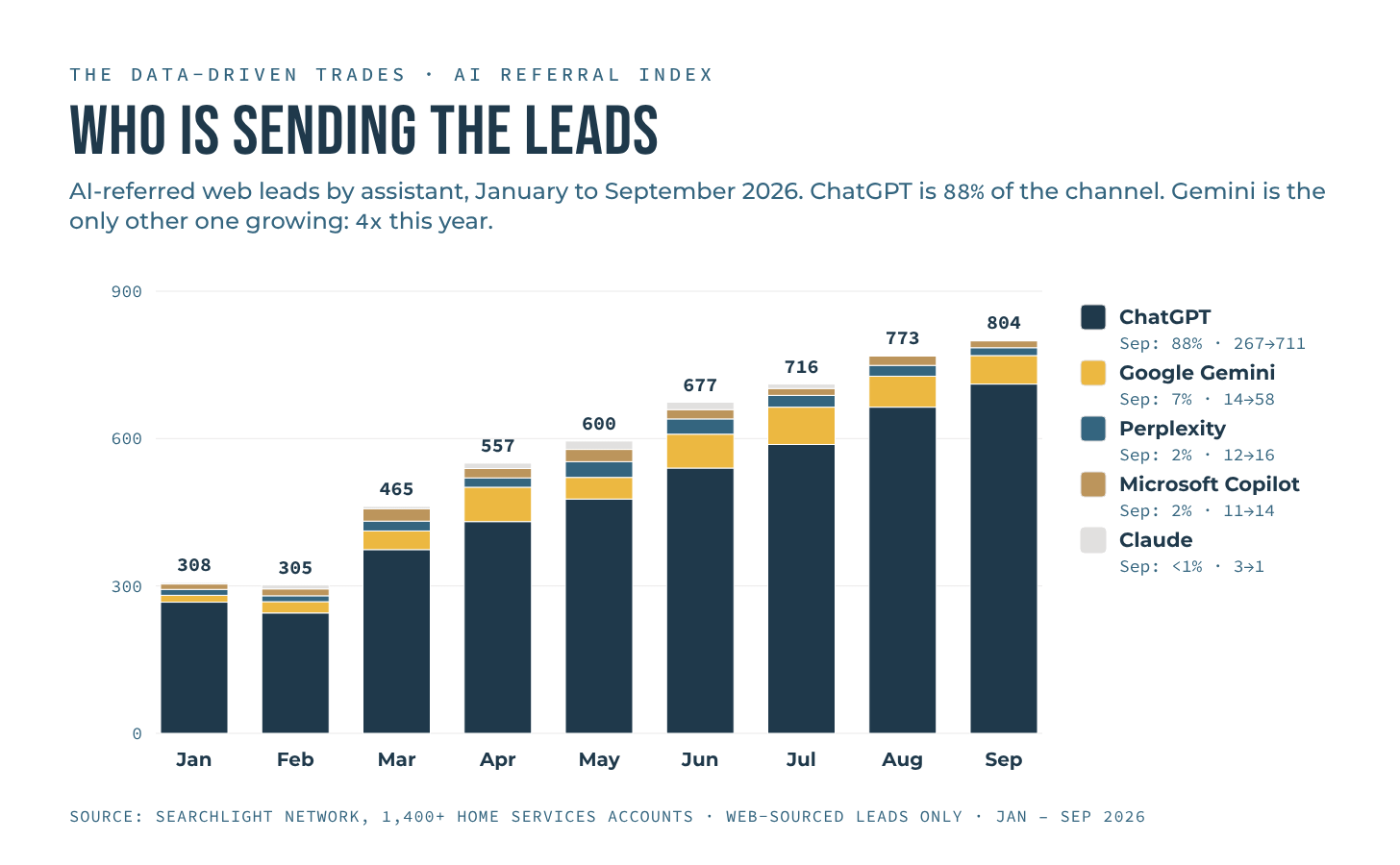
In September, 88% of AI-referred leads came from ChatGPT.
Google Gemini was second at 7%, Perplexity and Microsoft Copilot at about 2% each, and Claude under 1%.
The movement is in Gemini.
It went from 14 leads in January to 58 in September, roughly 4x, and its share of AI referrals went from 4.5% to 7.2%. Perplexity and Copilot have been flat all year.
If you are deciding which assistant to pay attention to beyond ChatGPT, it’s Gemini, which makes sense: Google is wiring it into the search page and the phone.
3. AI shoppers fill out forms. They don’t call.
This is the one I’d act on.
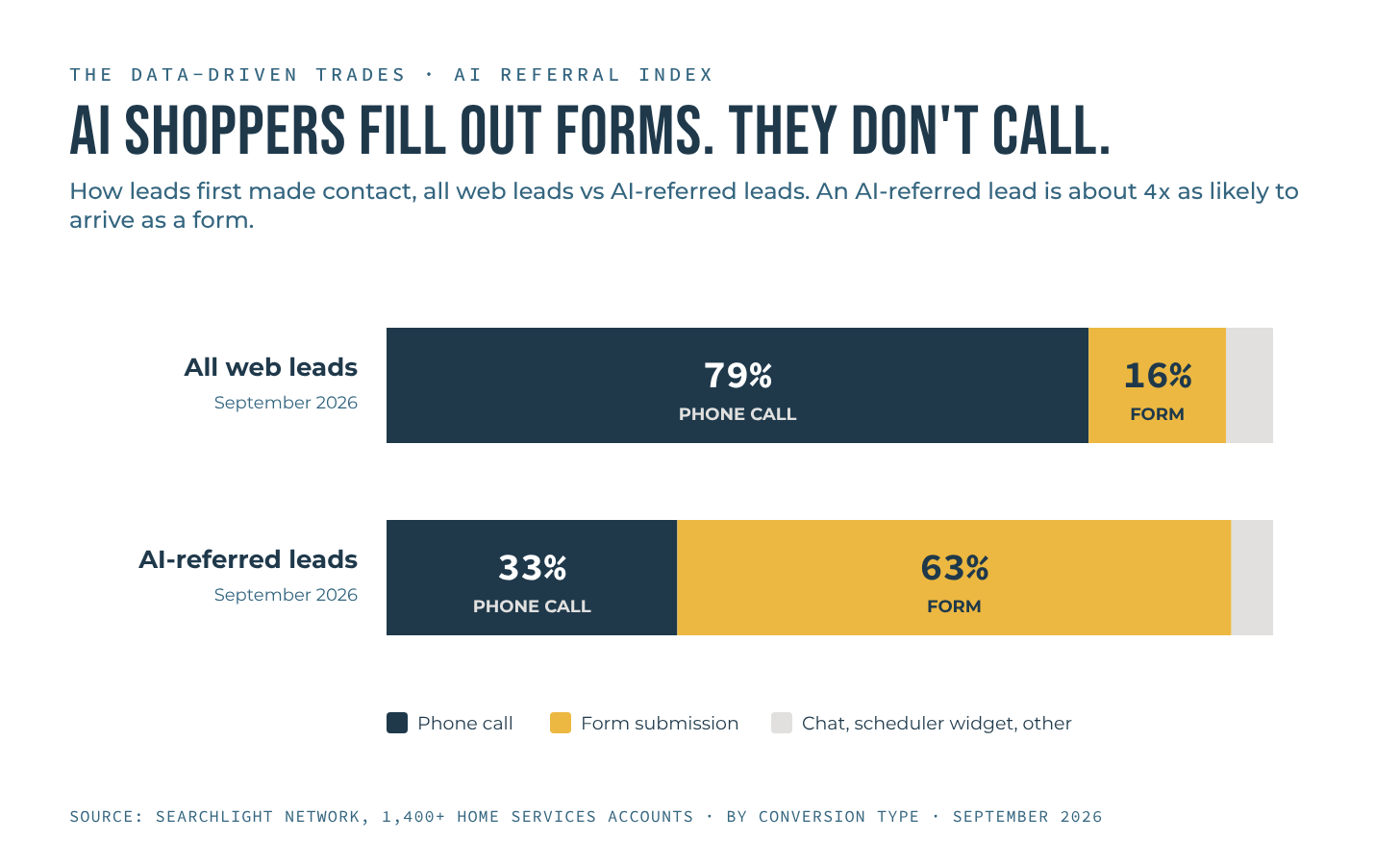
Across all web leads in September, 79% were phone calls and 16% were form submissions.
For AI-referred leads it flips: 63% came in as forms and 33% as calls.
Someone who asked ChatGPT “who should I call for a heat pump install in Raleigh” and then clicked your site is four times more likely to fill out your form than the average visitor.
They have already done the talking in the chat window. They arrive with a shortlist, not a question.
Part of this is measurement: a form submission carries the referrer, while a phone call must be matched to the session through dynamic number insertion, and some matches are lost.
But the gap is too wide to be tracking alone.
What it means for you: your form follow-up process is now your AI channel.
If forms sit for two hours while calls get answered in two rings, you are answering the slow-growing channel fast and the fast-growing channel slow.
If you want one metric to watch, it’s form response time. (I’ve got a separate piece coming on speed to lead; this is the same story from the other side.)
4. October: ChatGPT stopped tagging its links, and your Direct bucket got bigger
Around October 9, ChatGPT started opening links without the utm_source=chatgpt.com tag and without a referrer. Visits that used to show up as ChatGPT showed up as Direct.
OpenAI reportedly called it a technical error and tags largely returned around October 15, though some tracking vendors said they hadn’t seen a full recovery as of the 16th.
We saw it in lead data, with a lag.
ChatGPT referrals ran at about 18 per 10,000 web leads the week of September 28.
The week of October 5, they dropped to 13, a 26% fall.
The week of October 12, they came back to about 16. October to date is running 27% below September:
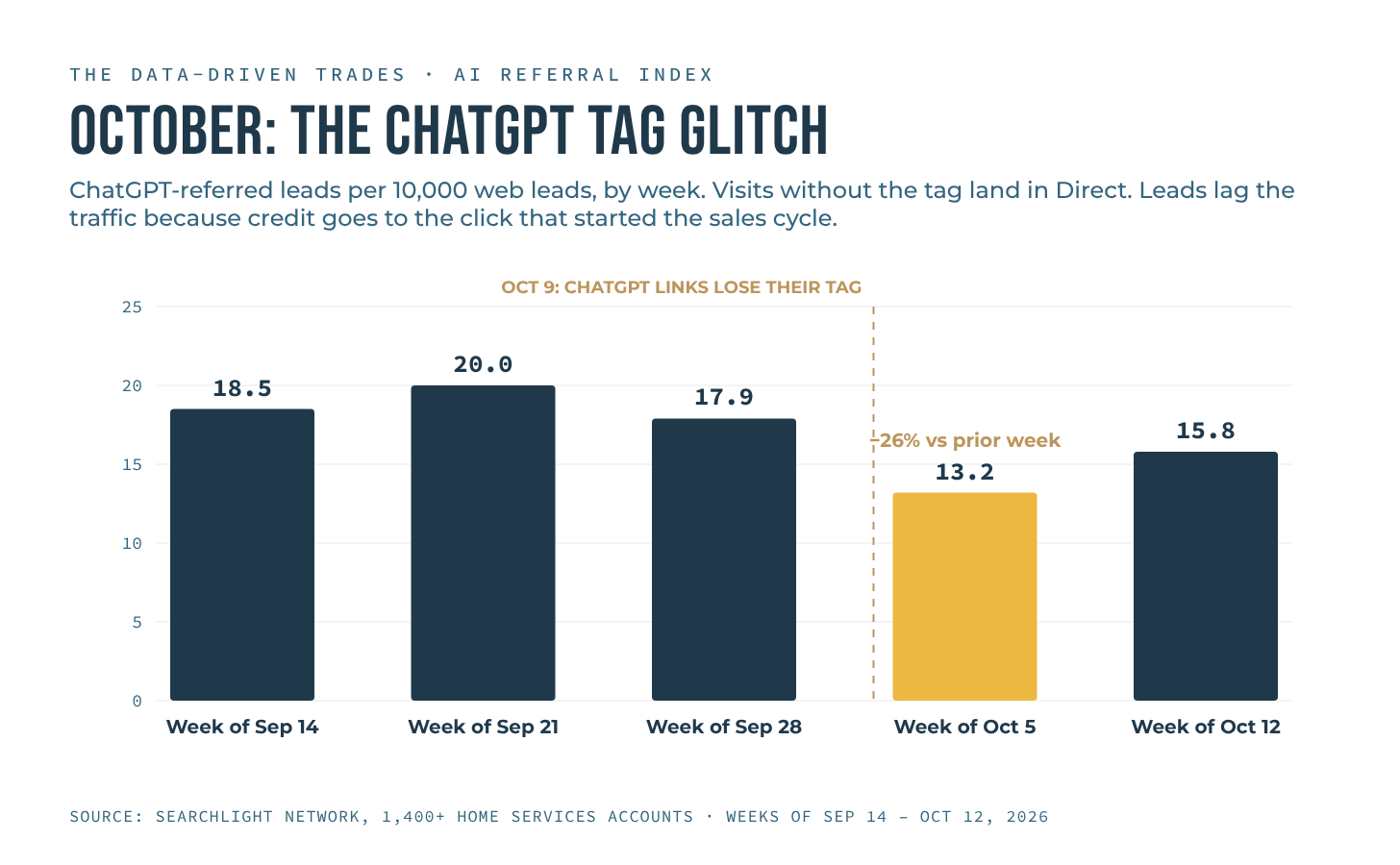
The lag matters. SearchLight credits a lead to the click that started its sales cycle, inside a 90-day window. A lead whose tagged ChatGPT visit happened in late September still counts as ChatGPT in mid-October, so the lead data understates how sharp the drop in site traffic was.
Two takeaways:
If your AI referrals fell in October, your demand probably didn’t. Look at your Direct line for the same weeks. That’s where the ChatGPT visits went.
Every AI number you see, including these, is a floor. Clipped UTMs, missing referrers, and the GBP hop (an assistant surfaces your Business Profile, the customer converts through it, GBP gets the credit) all push AI-sourced leads into other buckets. The real contribution is higher than what any dashboard shows.
What I’d do with this
Treat forms like calls. Form speed-to-lead is your AI channel’s booking rate. Put a human or an AI responder on it within minutes, not hours.
Watch Gemini. It is small, but it is the only assistant besides ChatGPT with a real growth curve, and it already lives inside Google.
Benchmark AI as a share, not a count. Your AI leads will rise with your overall volume and fall in the shoulder season. Track AI leads per 100 web leads, so a tracking glitch like October’s shows up as a share drop while Direct rises, instead of looking like lost demand.
Methodology
Network: 1,400+ home services accounts on SearchLight (HVAC, plumbing, electrical, roofing, garage door and related trades), January 2025 through October 21, 2026.
What counts as a web lead: a unique lead whose first contact came through a website form, a tracked phone call, a website chat, or an online scheduler widget. These are the touchpoints where a referrer or UTM can exist. Leads from Local Services Ads, pay-per-lead marketplaces, social lead forms, direct mail matching and CRM-originated call records are excluded from both the numerator and the denominator, because an AI assistant cannot be identified on them. September 2026 sample: about 330,000 web leads.
What counts as an AI referral: the lead’s session carried a referrer or
utm_sourcenaming ChatGPT, Google Gemini, Perplexity, Microsoft Copilot or Claude. Google AI Overviews are not included; they carry no assistant fingerprint and look like ordinary Google traffic.Unique leads, not conversions. A customer who called and filled out a form counts once. The form-vs-call split in section 3 is by conversion type, so a lead that did both appears in both.
Share, not counts. All trend comparisons are AI-referred leads per 10,000 web leads, so growth in the number of accounts on the network does not inflate the trend.
October is partial (through the 21st) and subject to the 90-day attribution lag described above.
Numbers come straight out of the SearchLight API. No CRM revenue or job data was used in this analysis.
The form-fill versus phone-call split seems especially actionable. Before investing heavily in AI search visibility, contractors could measure their average form response time and how many submissions turn into booked jobs. Isolating that conversion rate might reveal a bigger opportunity than increasing AI traffic itself.
The 1-in-400 framing is the useful part, and the temptation is to read the doubling as a trend when the base is still that small. At 0.25% of web leads the channel can absorb a lot of attention without moving revenue, so the real question isn't whether to invest in LLM referrals, it's what measurement you'd need for the number to be decision-grade. For contractors the binding constraint is usually that the lead never reaches a booked call, which no referral channel fixes on its own.
The same logic applies to ad accounts: a channel can grow 100% and still be a rounding error against the decisions you're making. nomu, a paid-traffic analytics software that answers in plain language, is what we build to make that read faster. https://nomu.paanalytics.net